
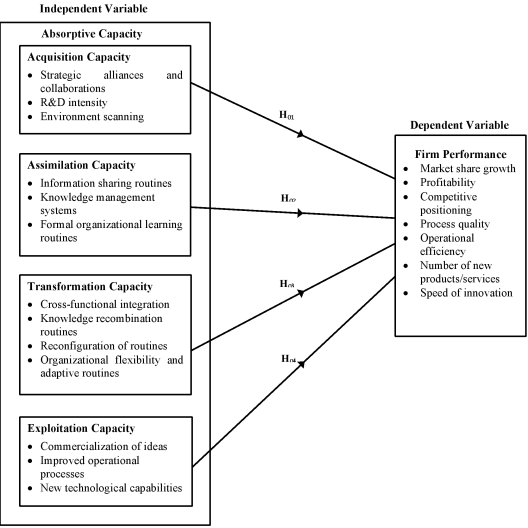
Organizations increasingly operate within digitally interconnected, knowledge-intensive ecosystems characterized by technological disruption, institutional volatility, and intense competition. In such environments, sustainable firm performance depends less on the ownership of static resources and more on the ability to acquire, assimilate, transform, and exploit knowledge in real time. Absorptive capacity has therefore emerged as a critical dynamic capability enabling firms to identify valuable external knowledge, internalize it through organizational learning processes, and strategically deploy it to enhance competitiveness. Despite its prominence, empirical findings on the relationship between absorptive capacity and firm performance remain mixed and inconclusive. This study reviews existing conceptual, theoretical, and empirical literature to identify key knowledge gaps and inform future research. Specifically, it disentangles the dimensions of absorptive capacity—knowledge acquisition, assimilation, transformation, and exploitation—to examine how they individually and collectively influence firm performance. Drawing on organizational learning theory and balanced scorecard theory, the study synthesizes prior evidence to explain how firms convert external knowledge into sustained performance outcomes. The review indicates that absorptive capacity enhances performance through improved learning, innovation capability, strategic adaptation, and operational efficiency. Notably, realized absorptive capacity dimensions (transformation and exploitation) exhibit a more direct relationship with firm performance than potential absorptive capacity (acquisition and assimilation). The study proposes a conceptual model linking absorptive capacity dimensions to firm performance and outlines directions for future research. It contributes to the strategic management literature by advancing a capability–performance perspective that emphasizes knowledge utilization processes over resource possession, particularly in dynamic and turbulent environments.
| Published in | European Business & Management (Volume 12, Issue 3) |
| DOI | 10.11648/j.ebm.20261203.11 |
| Page(s) | 38-49 |
| Creative Commons |
This is an Open Access article, distributed under the terms of the Creative Commons Attribution 4.0 International License (http://creativecommons.org/licenses/by/4.0/), which permits unrestricted use, distribution and reproduction in any medium or format, provided the original work is properly cited. |
| Copyright |
Copyright © The Author(s), 2026. Published by Science Publishing Group |
Absorptive Capacity, Firm Performance, Knowledge Management, Organisational Learning
ACAP | Absorptive Capacity |
KBV | Knowledge-Based View |
PACAP | Potential Absorptive Capacity |
RACAP | Realized Absorptive Capacity |
ROA | Return on Assets |
ROE | Return on Equity |
| [1] | Adepoju, A. O., & Fabunmi, D. O. (2024). Absorptive capacity and project-driven firm performance. European Project Management Journal, 14(1), 66–86. |
| [2] | Argyris, C. (1999). On Organizational Learning (2nded.). Blackwell Business: Oxford, United Kingdom. |
| [3] | Barney, J. (1991). Firm resources and sustained competitive advantage. Journal of Management, 17(1), 99–120. |
| [4] | Barney, J. B., (1991). Firm Resources and Sustained Competitive Advantage. Journal of Management, 15: 175–190. |
| [5] | Cameron, K. S., & Whetten, D. A. (1981). Perceptions of organizational effectiveness over organizational life cycles. Administrative Science Quarterly, 26(4), 525–544. |
| [6] | Camisón, C., & Forés, B. (2010). Knowledge Absorptive Capacity: New Insights for its Conceptualization and Measurement. Journal of Business Research, 63: 707-715. |
| [7] | Celik, A., & Balta, S. (2019). Strategic agility as a mediator between absorptive capacity and firm performance. Journal of Business Research, 101, 684–695. |
| [8] | Cho, S. J., Chung, C. Y., & Young, J. (2019). Study on the relationship between CSR and financial performance. Sustainability, 11(2), Article 343. |
| [9] | Cohen, W. M. & Levinthal, D. A. (1989). Innovation and Learning: The Two Faces of Research and Development. Economic Journal, 99(397): 569-596. |
| [10] | Cohen, W. M. & Levinthal, D. A. (1990). Absorptive Capacity: A New Perspective on Learning and Innovation. Administrative Science Quarterly, 35(1): 128- 152. |
| [11] | Cyert, R. M., & March, J. G. (1963). A behavioral theory of the firm. Prentice-Hall. |
| [12] | Dyer, J. H., & Singh, H. (1998). The relational view: Cooperative strategy and sources of interorganizational competitive advantage. Academy of Management Review, 23(4), 660–679. |
| [13] | Eisenhardt, K. M., & Martin, J. A. (2000). Dynamic capabilities: What are they? Strategic Management Journal, 21(10–11), 1105–1121. |
| [14] | Elkin, G., Pérez, A., & Jaramillo, H. (2018). Realized absorptive capacity and innovation in manufacturing SMEs in Colombia and Brazil. Journal of Technology Management & Innovation, 13(3), 68–79. |
| [15] | Espino-Rodríguez, T. F., & Taha, M. G. (2023). Absorptive capacity and supply chain integration and their impact on hotel service performance. Administrative Sciences, 13(12), Article 247. |
| [16] | Fiol, C. M., & Lyles, M. A. (1985). Organizational learning. Academy of Management Review, 10(4), 803–813. |
| [17] | Flatten, T. C.; Engelen, A.; Zahra, S. A. And Brettel, M. (2011). A Measure of Absorptive Capacity: Scale Development and Validation. European Management Journal, 29(2): 98-116. |
| [18] | George, G., Zahra, S. A., & Wood, D. R. (2002). The effects of business–university alliances on innovative output and financial performance. Journal of Business Venturing, 17(6), 577–609. |
| [19] | Grant, R. M. (1996). Toward a knowledge‐based theory of the firm. Strategic Management Journal, 17(S2), 109–122. |
| [20] | Jansen, J. J. P., Van den Bosch, F. A. J., & Volberda, H. W. (2005). Managing potential and realized absorptive capacity. Academy of Management Journal, 48(6), 999–1015. |
| [21] | Kaplan, R. S. & Norton, D. P. (1992). The Balanced Scorecard: Measures that Drive Performance, Harvard Business Review, 71-79. |
| [22] | Kaplan, R. S. & Norton, D. P. (1996a). The Balanced Scorecard: Translating Strategy into Action. Harvard Business School Publishing: Boston, United State of America. |
| [23] | Kaplan, R. S., & Norton, D. P. (2003). Strategy maps: Converting intangible assets into tangible outcomes. Harvard Business School Press, Boston, MA, United State of America. |
| [24] | Kaplan, R. S. & Norton, D. P. (2004). Strategy Maps: Converting Intangible Assets into Tangible Outcomes. Harvard Business Press, Boston, MA, United State of America. |
| [25] | Kaplan, R. S. & Norton, D. P. (2007). Using the Balanced Scorecard as a Strategic Management System. Harvard Business Review, July-August: 150–161. |
| [26] | Kela-Kahingo, C. M., Kinyua, G. M. & Muchemi, A. (2024). Strategic Flexibility as a Predictor of Organisation Performance in Commercial Banks in Kenya: The Mediating Role of Organisational Competences. International Journal of Education and Research, 12(10). 153-174. |
| [27] | Kim, K., Seo, E.-H., & Kim, C. Y. (2025). The relationships between environmental dynamism, absorptive capacity, organizational ambidexterity, and innovation performance from the dynamic capabilities perspective. Sustainability, 17(2), Article 449. |
| [28] | Kinyua G. M. (2015). Relationship between Knowledge Management and Performance of Commercial Banks in Kenya. Doctoral Thesis, Kenyatta University; Nairobi, Kenya. |
| [29] | Kinyua, J. K., Muchemi, A., & Kiiru, D. (2021). Antecedents of organization performance: Leveraging assimilation capacity in the context of insurance companies in Nairobi City County, Kenya. Journal of Business and Economic Development, 6(4), 202–211. |
| [30] | Kogut, B., & Zander, U. (1992). Knowledge of the firm, combinative capabilities, and the replication of technology. Organization Science, 3(3), 383–397. |
| [31] | Kotane, I., & Kuzmina-Merlino, I. (2015). Assessment of financial indicators for evaluation of business performance. European Integration Studies, 9, 216–224. |
| [32] | Lane, P. J., & Lubatkin, M. (1998). Relative absorptive capacity and interorganizational learning. Strategic Management Journal, 19(5), 461–477. |
| [33] | Lane, P. J., Koka, B. R., & Pathak, S. (2006). The reification of absorptive capacity: A critical review and rejuvenation of the construct. Academy of Management Review, 31(4), 833–863. |
| [34] | Levitt, B. & March, J. G. (1988). Organizational Learning. Annual Review of Sociology, 14: 319–340. |
| [35] | March, J. G. (1991). Exploration and exploitation in organizational learning. Organization Science, 2(1), 71–87. |
| [36] | Mogaka, D. M., Kinyua, G. M. & Kimencu, L. (2025). The Nexus between Inter-Firm Networks and Firm Performance: Context-Specific Empirical Evidence of the Interceding Role of Competitive Advantage. The International Journal of Humanities & Social Studies, 13(7): 57 – 73. |
| [37] | Muloko, K. T. & Kinyua G. M. (2026). Understanding the Nexus between Information Technology and Firm Performance: Insights from Food Processing Firms. The International Journal of Business & Management, 14(1): 66-75. |
| [38] | Muthoni, C. M. & Kinyua, G. (2026). The Nexus Between Communication Competence and Firm Performance: Insights from Commercial Banks in the Kenya Context. International Journal of Economics, Commerce and Management, 14(2): 31-56. |
| [39] | Nelson, R. R., & Winter, S. G. (1982). An evolutionary theory of economic change. Harvard University Press. |
| [40] | Njoroge, J. G., Muathe, S. M., & Bula, H. (2015). Human capital resource and performance of mobile phone companies in Kenya. International Journal of Education and Research, 3(10), 409–420. |
| [41] | Noblet, J. P., Simon, E. & Parent, R. (2011). Absorptive Capacity: A Proposed Operationalization. Knowledge Management Research & Practice, 9(4): 367- 377. |
| [42] | Nonaka, I., & Takeuchi, H. (1995). The knowledge-creating company. Oxford University Press. |
| [43] | Novak, A. (2017). Measuring value creation and firm performance beyond financial indicators. Studies in Business and Economics, 12(1), 79–84. |
| [44] | O’Connor, G. C., Ravichandran, T., & Robeson, D. (2008). Risk management through learning: Management practices for radical innovation success. The Journal of High Technology Management Research, 19(1), 70–82. |
| [45] | Obonyo, M. O., Kinyua, G. M. & Muchemi, A. W. (2026). Harnessing Knowledge Management Infrastructure Capability for Valuable Organizational Results: The Moderating Role of Regulatory Framework. Journal of Business and Economic Development, 11(1): 16-30. |
| [46] | Oketch, J. O., Kilika, J. M. & Kinyua, G. M. (2021). TMT Characteristics and Organizational Performance in a Regulatory Setting in Kenya. Journal of Economics and Business, 4(1): 79-92. |
| [47] | Ontita, J. & Kinyua, G. M. (2020). Role of Stakeholder Management on Firm Performance: An Empirical Analysis of Commercial Banks in Nairobi City County, Kenya. Journal of Business and Economic Development, 5(1): 26-35. |
| [48] | Peng, C. W., & Yang, M. L. (2014). The Effect of Corporate Social Performance on Financial Performance: The Moderating Effect of Ownership Concentration. Journal of Business Ethics, 123: 171–182. |
| [49] | Perdomo-Charry, G., Lozada-Barahona, E., & Zúñiga-Collazos, A. (2017). Exploitation capacity and firm performance: Evidence from Colombian firms. Espacios, 38(52), 24–35. |
| [50] | Randeree, K., & Al Youha, H. A. (2009). Strategic management of performance: An examination of public sector organizations in the United Arab Emirates. International Journal of Knowledge, Culture and Change Management, 9(4), 123–134. |
| [51] | Richard, P. J., Devinney, T. M., Yip, G. S., & Johnson, G. (2009). Measuring organizational performance: Towards methodological best practice. Journal of Management, 35(3), 718–804. |
| [52] | Shadrack, M. & Kinyua, G. (2025). Leveraging Strategic Leadership for Enhanced Performance: Empirical Evidence from Technical and Vocational Education and Training Institutions in Nairobi City County, Kenya. International Academic Journal of Human Resource and Business Administration, 5(1): 346-367. |
| [53] | Steers, R. M. (1975). Problems in the measurement of organizational effectiveness. Administrative Science Quarterly, 20(4), 546–558. |
| [54] | Teece, D. J., Pisano, G., & Shuen, A. (1997). Dynamic Capabilities and Strategic Management. Strategic Management Journal, 18(7): 509-53. |
| [55] | Teece, D. J. (2007). Explicating Dynamic Capabilities: The Nature and Micro- Foundations of (Sustainable) Enterprise Performance. Strategic Management Journal, 28(13): 1319-1350. |
| [56] | Teece, D. J. (2012). Dynamic Capabilities: Routines versus Entrepreneurial Action. Journal of Management Studies, 49(8): 1395-1401. |
| [57] | Todorova, G., & Durisin, B. (2007). Absorptive capacity: Valuing a reconceptualization. Academy of Management Review, 32(3), 774–786. |
| [58] | Tsai, W. (2001). Knowledge Transfer in Intraorganizational Networks: Effects of Network Position and Absorptive Capacity on Business Unit Innovation and Performance. Academic Management Journal, 44: 996–1004. |
| [59] | Tushman, M. L., & O’Reilly, C. A. (1996). Ambidextrous organizations: Managing evolutionary and revolutionary change. California Management Review, 38(4), 8–30. |
| [60] | Van den Bosch, F. A. J., Volberda, H. W., & de Boer, M. (1999). Coevolution of firm absorptive capacity and knowledge environment: Organizational forms and combinative capabilities. Organization Science, 10(5), 551–568. |
| [61] | Venkatraman, N., & Ramanujam, V. (1986). Measurement of business performance in strategy research: A comparison of approaches. Academy of Management Review, 11(4), 801–814. |
| [62] | Volberda, H. W., Foss, N. J. & Lyles, M. A. (2009). Absorbing the Concept of Absorptive Capacity: How to Realize its Potential in the Organization Field. Organization Science, 21(4): 931-951. |
| [63] | Volberda, H. W., Foss, N. J., & Lyles, M. A. (2010). Absorbing the concept of absorptive capacity. Academy of Management Perspectives, 24(4), 31–50. |
| [64] | Zahra, S. A., & George, G. (2002). Absorptive capacity: Review and reconceptualization. Academy of Management Review, 27(2), 185–203. |
APA Style
Warui, P. P. W., Kinyua, G. M. (2026). Revisiting the Absorptive Capacity–Firm Performance Nexus: An Integrative Review and Future Research Direction. European Business & Management, 12(3), 38-49. https://doi.org/10.11648/j.ebm.20261203.11
ACS Style
Warui, P. P. W.; Kinyua, G. M. Revisiting the Absorptive Capacity–Firm Performance Nexus: An Integrative Review and Future Research Direction. Eur. Bus. Manag. 2026, 12(3), 38-49. doi: 10.11648/j.ebm.20261203.11
@article{10.11648/j.ebm.20261203.11,
  author = {Peris Phylis Wagio Warui and Godfrey Muigai Kinyua},
  title = {Revisiting the Absorptive Capacity–Firm Performance Nexus: An Integrative Review and Future Research Direction},
  journal = {European Business & Management},
  volume = {12},
  number = {3},
  pages = {38-49},
  doi = {10.11648/j.ebm.20261203.11},
  url = {https://doi.org/10.11648/j.ebm.20261203.11},
  eprint = {https://article.sciencepublishinggroup.com/pdf/10.11648.j.ebm.20261203.11},
  abstract = {Organizations increasingly operate within digitally interconnected, knowledge-intensive ecosystems characterized by technological disruption, institutional volatility, and intense competition. In such environments, sustainable firm performance depends less on the ownership of static resources and more on the ability to acquire, assimilate, transform, and exploit knowledge in real time. Absorptive capacity has therefore emerged as a critical dynamic capability enabling firms to identify valuable external knowledge, internalize it through organizational learning processes, and strategically deploy it to enhance competitiveness. Despite its prominence, empirical findings on the relationship between absorptive capacity and firm performance remain mixed and inconclusive. This study reviews existing conceptual, theoretical, and empirical literature to identify key knowledge gaps and inform future research. Specifically, it disentangles the dimensions of absorptive capacity—knowledge acquisition, assimilation, transformation, and exploitation—to examine how they individually and collectively influence firm performance. Drawing on organizational learning theory and balanced scorecard theory, the study synthesizes prior evidence to explain how firms convert external knowledge into sustained performance outcomes. The review indicates that absorptive capacity enhances performance through improved learning, innovation capability, strategic adaptation, and operational efficiency. Notably, realized absorptive capacity dimensions (transformation and exploitation) exhibit a more direct relationship with firm performance than potential absorptive capacity (acquisition and assimilation). The study proposes a conceptual model linking absorptive capacity dimensions to firm performance and outlines directions for future research. It contributes to the strategic management literature by advancing a capability–performance perspective that emphasizes knowledge utilization processes over resource possession, particularly in dynamic and turbulent environments.},
 year = {2026}
}
TY  - JOUR
T1  - Revisiting the Absorptive Capacity–Firm Performance Nexus: An Integrative Review and Future Research Direction
AU  - Peris Phylis Wagio Warui
AU  - Godfrey Muigai Kinyua
Y1  - 2026/05/30
PY  - 2026
N1  - https://doi.org/10.11648/j.ebm.20261203.11
DO  - 10.11648/j.ebm.20261203.11
T2  - European Business & Management
JF  - European Business & Management
JO  - European Business & Management
SP  - 38
EP  - 49
PB  - Science Publishing Group
SN  - 2575-5811
UR  - https://doi.org/10.11648/j.ebm.20261203.11
AB  - Organizations increasingly operate within digitally interconnected, knowledge-intensive ecosystems characterized by technological disruption, institutional volatility, and intense competition. In such environments, sustainable firm performance depends less on the ownership of static resources and more on the ability to acquire, assimilate, transform, and exploit knowledge in real time. Absorptive capacity has therefore emerged as a critical dynamic capability enabling firms to identify valuable external knowledge, internalize it through organizational learning processes, and strategically deploy it to enhance competitiveness. Despite its prominence, empirical findings on the relationship between absorptive capacity and firm performance remain mixed and inconclusive. This study reviews existing conceptual, theoretical, and empirical literature to identify key knowledge gaps and inform future research. Specifically, it disentangles the dimensions of absorptive capacity—knowledge acquisition, assimilation, transformation, and exploitation—to examine how they individually and collectively influence firm performance. Drawing on organizational learning theory and balanced scorecard theory, the study synthesizes prior evidence to explain how firms convert external knowledge into sustained performance outcomes. The review indicates that absorptive capacity enhances performance through improved learning, innovation capability, strategic adaptation, and operational efficiency. Notably, realized absorptive capacity dimensions (transformation and exploitation) exhibit a more direct relationship with firm performance than potential absorptive capacity (acquisition and assimilation). The study proposes a conceptual model linking absorptive capacity dimensions to firm performance and outlines directions for future research. It contributes to the strategic management literature by advancing a capability–performance perspective that emphasizes knowledge utilization processes over resource possession, particularly in dynamic and turbulent environments.
VL  - 12
IS  - 3
ER  -
Department of Business Administration, Kenyatta University, Nairobi, Kenya
Department of Business Administration, Kenyatta University, Nairobi, Kenya

Information



 Share This Article
 Twitter
 Linked In
 Facebook
 Copy
Copy Download